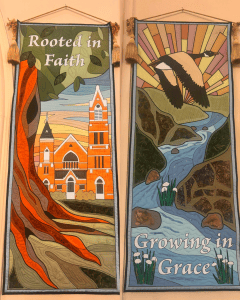
written by Kathy Manis Findley
Banners created by Sharon Bailey and a Dedicated Group of Faithful People, Karen Mitcham, Deann Duke, Kathy Myers, Sarah McCommon, Lucy Wilson, Eric O’Dell and Helen O’Dell Kemp, who did the graphic design, as well as Sharon’s neighbor Ed Emory who printed the designs onto fabric.
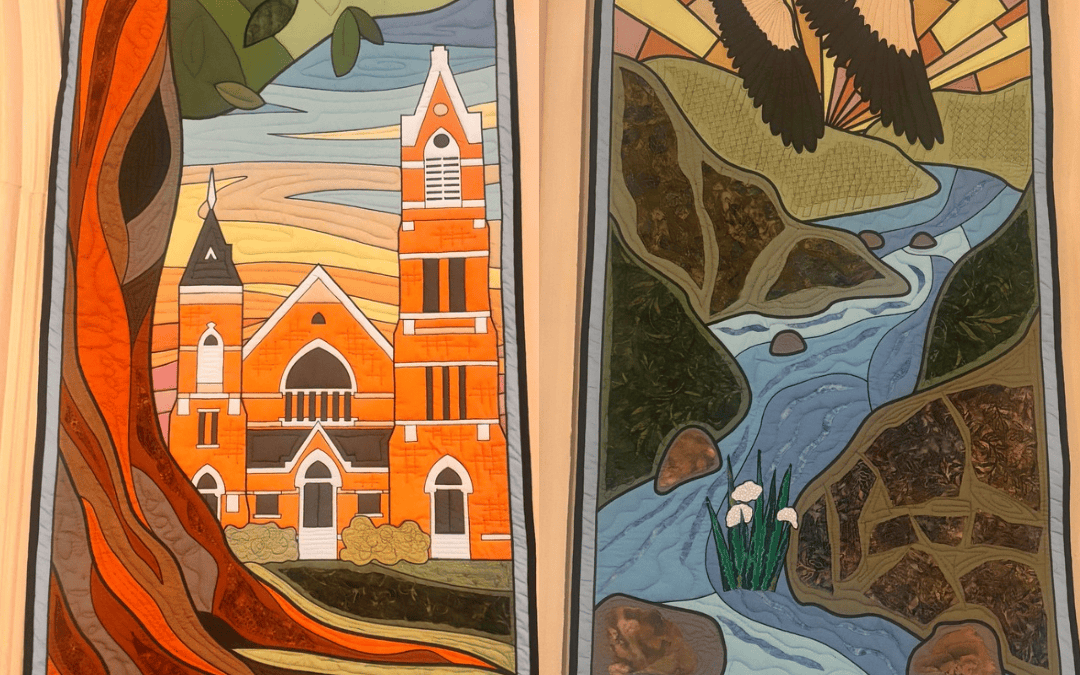
The First Baptist Church of Christ in Macon, Georgia, created the banners in the photo above on the occasion of the Church’s 200th Anniversary. What a stunning tribute from a small group who gathered to create these banners as an act of love for their Church. They gave hours and hours of their time, labor and creativity to create these banners—meticulously, reverently, faithfully— stitch by stitch. They chose the themes, “Rooted in Faith” and “Growing in Grace” from the theme selected for the church’s bicentennial year.
What better themes could describe The First Baptist Church of Christ and her people. “Rooted in Faith”— these carefully chosen words describe a people whose faith persisted for 200 years, and throughout those years graced one another and their community by providing generous help when the community was in need and by taking bold stands and making profound statements about many previously taboo issues like racial justice, the precarious status of women in the church, the ordination of women, and full acceptance of persons who describe themselves as being a part of the LGBTQI+ community. Their primary message was that all of these groups of people are blessed creations, precious sons and daughters of God, and thus cherished by the people of God.
The second banner, “Growing in Grace,” describes the inner soul that grows in the congregation and in each worshipper with every Scripture shared, every hymn sung, every person baptized, every testimony offered, every sermon preached, every choir anthem, every singer’s song, every instrument played, every bell rung, every candle lit, and every bread and cup shared among them. The “trappings” of the Church are designed to remind every person that they are a beloved child of God and encourage them to continually “grow in grace.”
Near the end of the banner creation, one of the group of banner creators said something like this: “To depict ‘growing in grace’ we might need one more element for the banner. We might need flowers growing in the waters of the stream.” And so they went on a search for small, lily-like flowers.
What they found in their research was the Hymenocallis coronaria, commonly known as the Cahaba lily, shoal lily, or rocky shoals spider-lily, which is a rare aquatic perennial flowering plant growing in Alabama, South Carolina and Georgia. right in the middle of fast-moving, shallow rivers. These lilies anchor themselves in rocky shoals, clinging to submerged stones where the current is strong and the sun beats down on them all day. Each individual flower only lasts for a single day, The Cahaba Lily is often considered one of the South’s most treasured wildflowers—not only for its beauty, but for its rarity and that it grows in a unique environment along the Cahaba River. This flower is considered a vulnerable species. Dams, pollution, and habitat disruption have all contributed to its decline. In many ways, the lilies are a metaphor for the Church.
Often, flowers are not planted by people, especially in streams of water. They are not cultivated, not bothered at all. They just appear where they will, wildflowers with a bit of magic. After all, isn’t there a little magic and mystery in faith, in worship, in the Church, and even in the creation of these stunning banners?
Consider the metaphors between the flowers and the First Baptist Church of Christ in Macon Georgia. A vulnerable species —the vulnerability of a large downtown church with its unique challenges. A unique spider-like lily—a church that stands out because of its stance on progressive issues. A wildflower that grows in the midst of fast-moving shallow rivers—a church that always faces the fast-moving current of critical social justice issues. The Cahaba lily’s stunning, beautiful bloom—the church’s beautiful interior snd exterior. The Cahaba lily’s habit of lasting just one day—the church’s urgency of time to cultivate genuine faith among her people.
Anyway, the flowers placed on the banner look like diminutive little flowers, carefully placed on the banner, “growing in grace.” And all the people called them the final touch.
She said, I am only a little rose or autumn crocus of the plain of Sharon, or a humble lily of the valleys that grows in deep and difficult places.
~ Song of Solomon 2:1 AMPC
Sometimes when I’m feeling small and weak, I hope I am reminded of the small flowers in the stream and know that I am needed to be a “final touch” person of faith. In God’s timing and by God’s grace, I will know my soul’s mystery, and know that I am needed for the work of the Kindom. “The final touch.” We are tiny in the big scheme of things, but as we grow in grace, rooted in solid ground, we can be mighty.
And so it is with all the ways the Church grows, tiny churches and mighty ones! Amidst all of the ways a church grows, by sacred mystery and a holy ebb and flow, She declares to the world that She is still present beyond earthquake, tornado and hurricane, beyond “deep and difficult places,” still standing tall. On the highest peak in the city that surrounds Her at the top of Poplar. Her steeple rises above the city, a beacon of light and hope. Through all of her toils and turmoils in 200 years of life, the church declares, “We are still here after all these centuries, for our people and for the people of our community, and most of all, to bear witness to the glory of the everlasting God, rooted in faith and growing in grace.
Wait for us! We might appear suddenly as tiny flowers in streams of living water.